
A Model for Managing Innovation
Publications
A Model for Managing Innovation
Challenges and solutions for effectively taking new products and services to market
Managing innovation isn’t just about generating great ideas – it’s about systematically channeling creative energy into concrete products and services that actually reach the market. In our experience, doing this effectively requires process, governance, clear roles and the right interactions across the organization.
The drive to innovate is top of mind across virtually every industry. Yet while most companies have no shortage of creative energy circulating in their corridors, many struggle to bridge the gap between raw ideas and commercial outcomes.
And it’s no wonder: CMOs, CPOs, marketeers and strategists find themselves navigating an increasingly complex landscape. Consumers are increasingly driving the narrative, startups are compressing time-to-market expectations, AI is disrupting conventional ways of working and creating, and financial pressure on margins and portfolio performance is mounting.
Understanding culture as a strategic lever
At the same time, innovation doesn’t happen in isolation from day-to-day business realities. Leaders must still organize massive internal structures, manage dozens of stakeholders and interdependencies, while also dealing with the practical demands of production, procurement and go-to-market execution. This leaves executives in an uncomfortable juggling act: deliver short-term results while trying to innovate beyond the core.
This report addresses a recurrent set of pain points we’ve encountered across our engagements with diverse companies: misalignment between strategy and innovation efforts, insufficient communication across areas, unclear accountability and governance that either adds bureaucracy or lacks the right controls.
We present Integration’s four-pillar Innovation Management Model, drawn from years of hands-on experience across sectors and geographies:
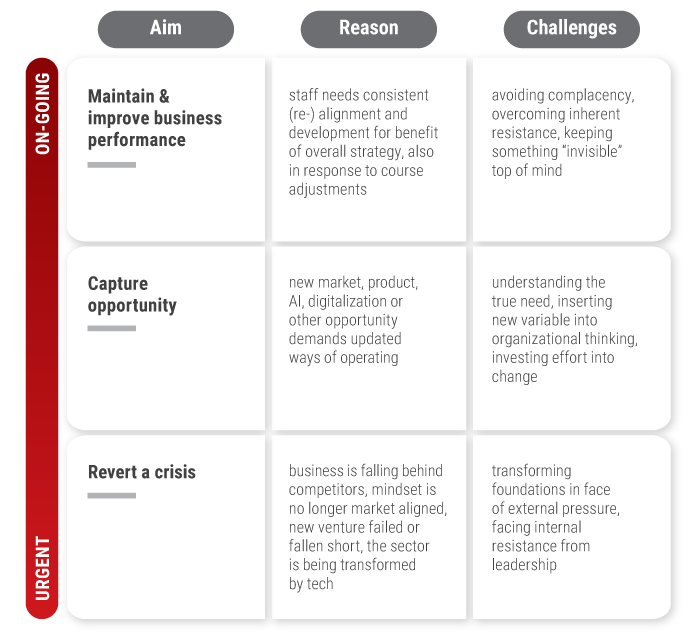
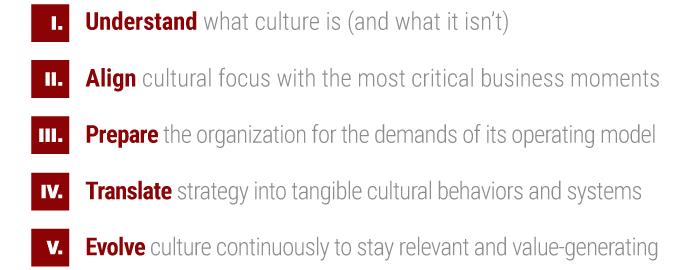
There’s no such thing as a right or wrong culture: it’s about consciously defining which culture is most suitable to the business at hand – for its strategic goals, values and essence. Organizational culture can be shaped to support the business strategy and transformation, calling on executives to pay close attention to whether the prevailing “personality” is advancing the strategy or perhaps hindering it.
Take culture from theory to practice
Through our work across 3,630+ projects and engagement with 500+ CEOs annually, we’ve found that while nearly 9 out of 10 executives recognize the importance of developing and aligning their organizational culture, many get lost when tasked with translating the theory behind culture into reality. Nearly half of executives we surveyed admit that their organizations lack specific tools to measure culture, while a third lack supporting rituals.
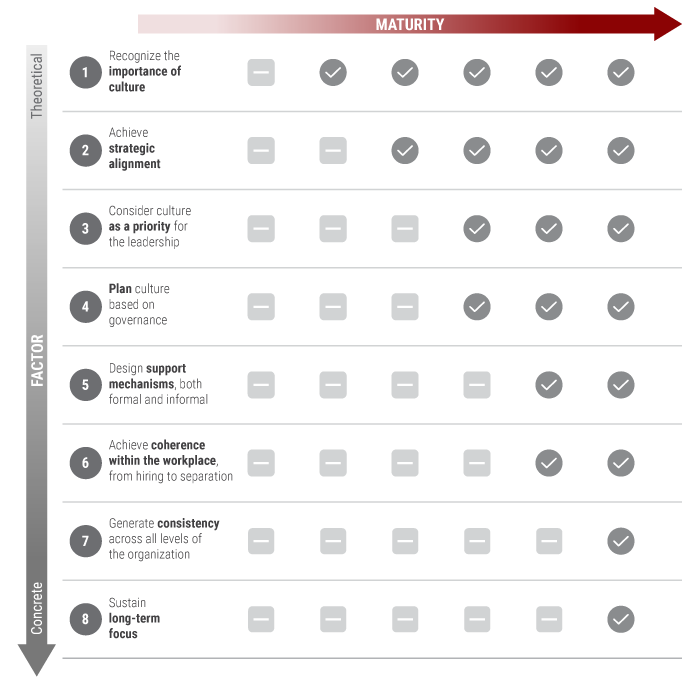
Download the full report to access our Cultural Transformation Disruption Matrix, the Cultural Redefinition Cycle, practical instruments for embedding culture into day-to-day operations, and real case examples from M&As, industry transformations, and strategic pivots.
FIND OUT MORE BY READING THE FULL REPORT
TALK TO US

André Valente
André Valente is a partner at Integration and leader of our Marketing & Sales practice. He has been part of the company since 2012 and holds nearly 20 years of experience in strategy and transformation projects – with a focus on marketing, innovation, sales and growth. André has worked on more than 50 projects across [...]

Augusto Ribeiro
Augusto Ribeiro is a partner at Integration and has been working since 2003 in the Marketing & Sales practice. Augusto built a solid international experience, leading and implementing strategic Marketing & Sales projects in industries ranging from Consumer Goods through Construction & Property Development to the Financial Industry, especially in the Private Equity sector.

Guido Solari
Guido Solari is a partner at Integration and the head of our LATAM offices. Guido joined the company in 2006 and is part of the Marketing & Sales Practice. He has carried out over 250 projects across Latin America, North America and Europe, serving clients in the areas of mass consumer goods, agribusiness, pharmaceuticals, media [...]

Jamie Gale
Jamie Gale is a partner at our London Office. He has spent more than 25 years in the consulting industry and private sector. Jamie is recognized for his extensive experience in digital, developing and executing strategies that enable business transformation. He has supported clients across manufacturing, retail, telecommunications, financial services, food & beverage and transportation [...]

Jonathan Ezban
Jonathan Ezban is a senior director at Integration and has been working since July 2011 in the practice of Marketing & Sales. Prior to Integration, Jonathan was an Analyst at The Friedman Group, where he developed projects related to Sales Budgets for retail companies in Mexico. Within Integration, we can highlight his experience in Market [...]

Paulo Guimarães
Paulo Guimarães is a senior manager in Marketing & Sales, working in the company since October 2014. His experience includes projects related to strategic planning, go-to-market design, market sizing, commercial model & structure revision, financial simulation, due diligence and commercial policy in sectors such as technology, durable & nondurable consumer goods, infrastructure, private equity and [...]

Sven Hoffmann
Sven Hoffmann is a senior manager at Integration's Munich Office. His experience covers projects in the areas of strategic planning and roadmaps, organizational and process redesigns, go-to-markets and innovation systems. Sven has worked in projects across Asia, Europe, North and South America. He holds a master's degree in technology management from the Technical University of [...]
- On 9 December 2025