

Food System Transformation
Publications
Food System Transformation
Knowing how, where and when to plant the seeds for your own disruption
For leaders across the food and beverage value chain, the question is no
longer whether the food system is being disrupted but how to position
your business within it.
The viability of conventional ways of producing, selling and consuming
food is increasingly in question, while innovative responses emerge almost
monthly. Most executives already recognize the need to act.
What’s far less clear is when to move, how big to
go and where to start.
The pressures are hard to ignore. The global population is set to grow 25% to 9.6 billion people by 2030 – each of whom needs food – as our arable land, water supplies and biodiversity decline. Today, the food system already accounts for 26% of greenhouse gas emissions, a third of all food produced is lost as waste and an estimated USD 2.7 trillion is spent each year treating food-related illnesses.
Consumer behavior, investment flows and regulation are all moving in the same direction, and the economics of alternative products are steadily approaching parity with conventional ones.
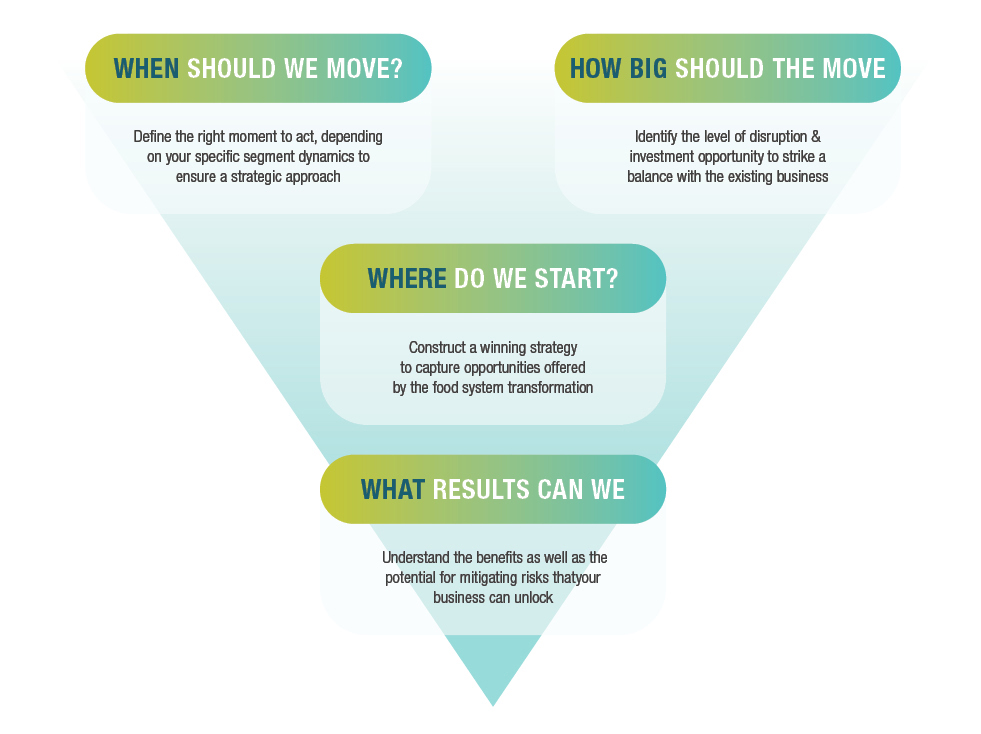
For the CEOs we work with, this raises three recurring questions:
- When should we move? Reading the signals across consumers, investments and regulation, which indicate the platform is starting to burn.
- How big should the move be? Calibrating the level of disruption and investment against your existing business, where context is king and there’s no one-size-fits-all formula.
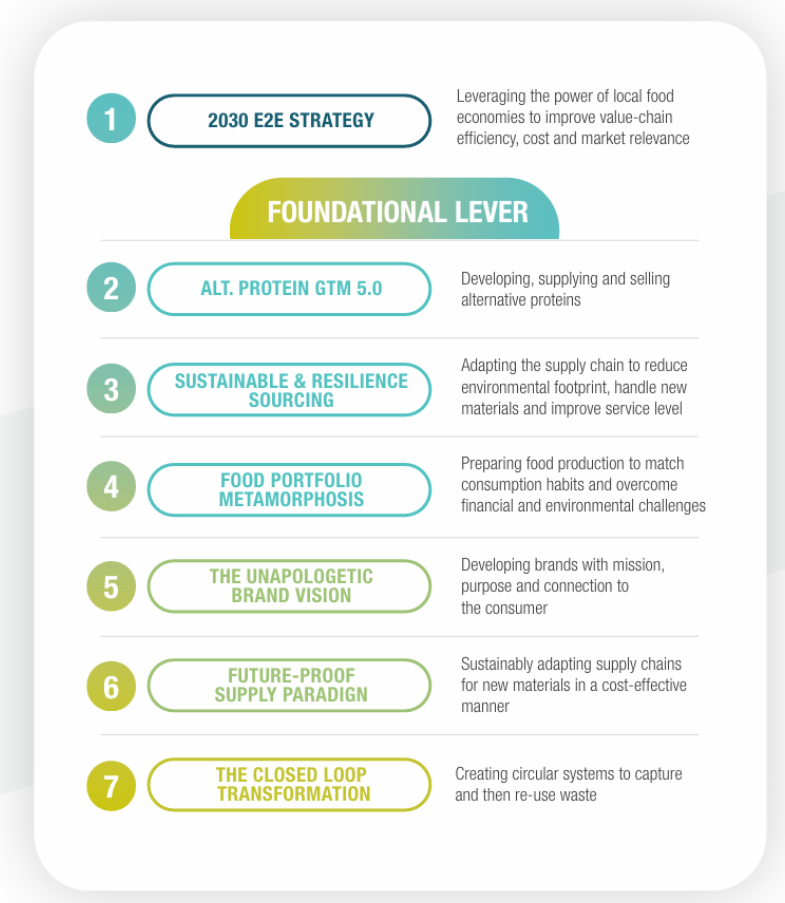
- Where do we start? Locating your business along seven key transitions and identifying the right entry point, be it a complete end-to-end strategy or a single, targeted challenge.
The rewards of acting – and the risks of waiting
Companies that act early stand to unlock access to one of the fastest-growing sectors, innovator status in the marketplace, stronger brand equity and a greater ability to attract and retain the right talent.
Those that hesitate face mounting risks: unpreparedness for incoming legislation, fines from non-compliance and eroding competitiveness as disruptors gain ground. As history across disruptive industries has shown, waiting too long carries real consequences.
From questions to a roadmap
Drawing on Integration’s experience guiding businesses across the food value chain, this report provides guidance for companies to move from diagnosis to action with the impending food system transformation.
It maps the seven key food system transitions (from a 2030 end-to-end strategy and alternative-protein go-to-market models to sustainable sourcing, portfolio metamorphosis, brand vision, future-proof supply chains and closed-loop circularity). Thes are grounded in real client cases, including a cultured-meat startup sizing a nascent market and a global ingredients player that set its operations on a path to 6% CAGR.
We invite you to download the full report to access the seven-transitions framework, the signals that indicate when to move, illustrative client cases and Integration’s perspective on how to plant the seeds for your own disruption.
DOWNLOAD THE FULL REPORT
TALK TO US

Daniel Lentfer
Daniel Lentfer is a senior manager at Integration and has been part of the Munich Office since 2016. Daniel leads Integration’s Marketing & Sales area in Europe. His experience includes growth strategies, distribution, go-to-market, market & customer segmentation, key account management, business planning and many related topics. Prior to Integration, he worked as a political [...]

Jamie Gale
Jamie Gale is a partner at our London Office. He has spent more than 25 years in the consulting industry and private sector. Jamie is recognized for his extensive experience in digital, developing and executing strategies that enable business transformation. He has supported clients across manufacturing, retail, telecommunications, financial services, food & beverage and transportation [...]
Julian Lempp
Julian Lempp is a senior director at Integration's Munich Office. He has experience both within consulting and industry, having previously worked for a leading German consultancy and as a business development manager within an industrial goods manufacturer. While he has experience across many project types, his specialization lies in supply chain, having undertaken numerous consulting [...]

Rodrigo Seabra
Rodrigo Seabra is the partner at our Office in Munich. He joined Integration in 2006 in Brazil and led the Mexico Office, before taking on responsibility of the Munich Office. Rodrigo is part of our Implementation Practice, has amassed international experience in industries such as consumer goods, retail, food & beverage, pharmaceutical and healthcare and [...]

Sven Hoffmann
Sven Hoffmann is a senior manager at Integration's Munich Office. His experience covers projects in the areas of strategic planning and roadmaps, organizational and process redesigns, go-to-markets and innovation systems. Sven has worked in projects across Asia, Europe, North and South America. He holds a master's degree in technology management from the Technical University of [...]

Vinicius Olivo
Vinicius Olivo is a senior director and brings a broad and deep understanding of our Marketing & Sales solutions since having joined Integration in 2011. He supported leading national and international organizations in Retail and Consumer Goods in building sustainable competitive advantage. His project experience ranges from Go-to-Market models, Market Scans, Customer Segmentation, Category Management [...]
- On 26 March 2025