


The commercial jungle: A practical approach to revenue growth management beyond the numbers
Publications
The commercial jungle:
A practical approach to revenue growth management beyond the numbers
For consumer goods companies, revenue growth management isn’t just a matter of
sophisticated pricing analytics. It’s about translating those insights into behaviors,
incentives and organizational practices that can be executed within your commercial
reality and absorbed by your company’s culture.
The math is right – but results aren’t following. For companies emerging from years of cost-cutting, revenue growth management (RGM) is back on the executive agenda. While a 1% price improvement can yield 10-15% gains in net margin, one essential insight is often overlooked: Non-technical elements make or break effective RGM strategies.
Companies are investing millions in data platforms, pricing tools and sophisticated analytics. These solutions can produce brilliant theoretical strategies, yet many organizations struggle to turn them into measurable bottom-line impact. As experience has taught us, strategy execution doesn’t happen in a vacuum – it’s shaped by internal capacity, cross-functional friction, misaligned incentives and the lived commercial realities of clients, partners and the sales force.
In this report, we explore Integration’s proven framework for RGM success through:
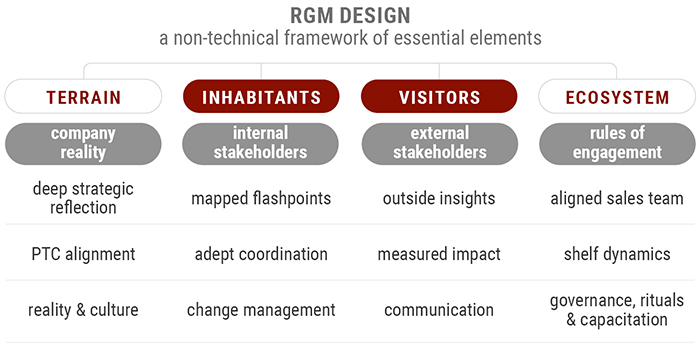
- The 4-dimension “RGM Jungle” framework – Mapping the interconnected elements across Terrain (company reality), Inhabitants (internal stakeholders), Visitors (external stakeholders) and Ecosystem (rules of engagement)
- Design phase essentials – From deep strategic reflection and PTC alignment to managing stakeholder flashpoints and understanding client realities
- Implementation success factors – Setting the right speed and scope, sustaining collaboration through change, maintaining external engagement and governing responsively
- Real case examples – Practical scenarios from personal care, food, pharmaceutical and health & beauty companies navigating complex pricing transformations
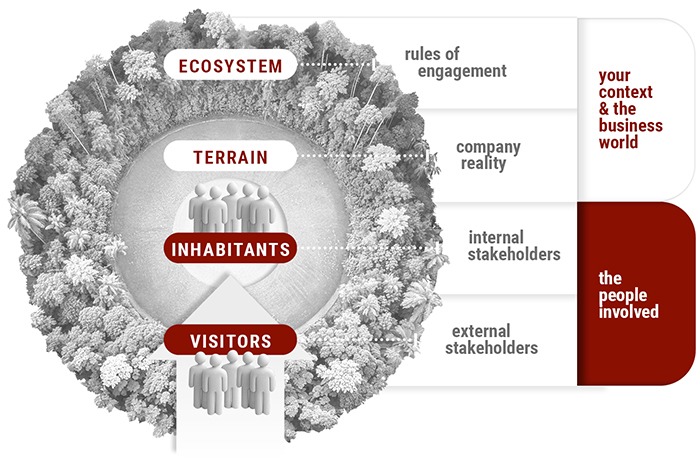
Beyond the analytics: Understanding what really drives RGM success
Too often, RGM initiatives underperform because leaders underestimate the complexity of changing prices in live markets with real client relationships. Our experience across diverse markets shows that technical tools only go so far – revenue strategies win or fail based on how well they’re translated into behavior, processes and decision-making rhythms.
Key success factors include clarifying business priorities before over-engineering pricing logic, anchoring price-to-consumer thinking in market realities, involving key stakeholders early, and treating RGM as a capability build rather than a one-off rollout.
From design to results
The report provides actionable guidance across both strategic design and tactical implementation:
Design considerations cover strategic reflection on whether RGM is the right response, PTC alignment across marketing and commercial teams, mapping potential implementation flashpoints, gathering outside insights from clients and channels, and addressing sell-in/sell-out imbalances.
Implementation realities address setting practical timing based on organizational readiness, pairing governance with flexibility, activating change management early, providing structured external stakeholder support and establishing responsive governance rituals.
Organizations that approach RGM holistically have seen measurable impact across several fronts:
- 10-15% net margin improvement from modest, well-positioned pricing moves
- Protected margins across the chain by aligning commercial policy with strategy
- Lower disruption risk through phased rollout tuned to the company’s maturity and appetite
- Stronger cross-functional alignment connecting sales, marketing and finance goals
- Better long-term outcomes – with iteration, learning and alignment replacing reactive fixes
Our full report offers a complete roadmap, from strategy to real-world results.
FIND OUT MORE BY READING THE FULL REPORT
TALK TO US

Alejandro Velez-Mejia
Alejandro Velez-Mejia is a senior manager in the Chicago Office at Integration and has been working in the company since July of 2023. Prior to Integration, Alejandro worked as a competitive strategy manager at Abbott, and before that as a consultant at boutique firms across Latin America and the US. He has management consulting, venture [...]

Fábio Goulart
Fábio Goulart is a senior manager at Integration's Finance & Management Practice. He worked at Integration from 2018 to 2021 and rejoined the company in July 2023. In addition to Integration, Fabio has worked in Growth Strategy at Isaac (Fintech for Education), and in Revenue Management at AB-Inbev. His consulting experience includes projects in Revenue [...]

Guido Solari
Guido Solari is a partner at Integration and the head of our LATAM offices. Guido joined the company in 2006 and is part of the Marketing & Sales Practice. He has carried out over 250 projects across Latin America, North America and Europe, serving clients in the areas of mass consumer goods, agribusiness, pharmaceuticals, media [...]

Hugo Ribeiro de Almeida
Hugo Ribeiro de Almeida is a founding partner at Integration and can count on more than 30 years of experience in consulting. Hugo, who holds a post-graduate degree in Business Administration from Harvard University, is a senior specialist in the area of Finance & Management and frequently leads projects in Organizational Structure, Strategic Planning, M&A, [...]

Ian Matiussi
Ian Matiussi is a senior director and joined Integration in 2010 and now has over a decade of experience, working in our Marketing & Sales Practice. Comfortable with a wide range of topics in this area, he is especially known for his expertise in strategic marketing initiatives such as Market Scans, Go-to-Market and Commercial Policy. [...]

Jorge Gomes
Jorge Gomes is a senior director and a highly experienced professional in our Finance & Management practice having joined Integration in 2008. Jorge has travelled to countries around the world in support of our clients, leading projects related to revenue management, strategic planning, M&A and more. He has a well-rounded experience having completed multiple projects [...]

Júlia Fukushima
Júlia Fukushima is a senior manager at Integration and has been working since August 2014 in the Finance & Management practice. Before Integration, Júlia worked as an intern at Grupo Ultra and Grupo 3A. Her experience includes projects in Market Scan, Marketing Plan, Strategic Plan and Go To Market, in sectors such as Pharmaceutical, Surgical [...]

Luis Bernal
Luis Bernal is a director in the Marketing & Sales Practice. Originally from Columbia, Luis is an entrepreneur at heart, and has worked in several start-ups in Colombia, receiving his MBA from IPADE. He has accumulated international consulting experience whilst working across the United States, Mexico, Caribbean and Central America, Colombia and Brazil in industries [...]

Marília José
Marília José is a Sr Director at Integration and has been with the firm since 2014. With expertise in Supply Chain and Finance & Management, she specializes in S&OP, retail supply chain, efficiency and cost reduction, and transformation projects. Her experience spans post-merger integration, strategic planning, organizational model development and process design, across the retail, [...]

Quentin Girard
Quentin Girard is a partner and has worked in our São Paulo Office since 2013, specializing in Finance & Management projects. He has led engagements across a wide array of countries in Europe, South America and Central Asia. His primary experience includes projects related to Route to Market, Cost Efficiency, Cost-to-Serve and Strategic Roadmap Design, [...]

Virgínia Ruggiero
Virgínia Ruggiero is a senior manager at Marketing & Sales and has been part of the Integration since May 2015. During this period, she has carried out diverse projects in strategic planning, market scans, entry strategies, mergers & acquisitions, due diligence, go-to-market and category management, mainly in the sectors of retail, education, health care, apparel, [...]
- On 20 January 2026